Since bombing my way through
Death Comes to Pemberley I've been reading a rather electrifying cluster of other things ... which I will now proceed to summarise in blog-style, semi-bitesize fashion.
1. Anthony Trollope, The Warden
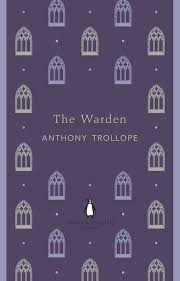
I had a few friends at university, and one boyfriend, who were big Trollope fans, but our tutor didn't get us to read any during the eight short weeks we 'did' Victorian literature, and, already lumbered with the bricks that were
Bleak House and
Middlemarch and
Our Mutual Friend and so on, I left him well alone. I think it is a combination of having moved to the country and a dip back into Thomas Hardy that raised the idea of reading some Trollope in my mind, so I bought
The Warden in a spanking new, very elegant
Penguin edition with lovely stripes on the spine and the back. This is the first of the Barchester novels, and is also very short, so I thought it might be a good place to start.
The Warden follows the moral crisis of a quiet, cello-playing clergyman who, through generations of complacency and inflation, receives a huge income as the warden of a lodging house for poor, retired men of the parish. The sum was originally meant to give the warden a comfortable living and provide for the men's board, but whilst the warden's portion has increased, the men's daily allowance has remained the same. A young doctor, burning with the flames of righteousness, decides to stoke up the residents into signing a petition asking for their fair share, which throws the poor warden, Septimus Harding, into shock and disorientation.
Like Tolstoy and indeed Hardy, Trollope has such enormous compassion for nearly all his characters -- perhaps with the exception of Dr Grantly, the archdeacon -- that you can't help becoming rather passionate about what could be described as a dated Anglican quibble. Mr Harding tends to mime cello-playing behind his back during uncomfortable conversations, and, if things get too troubling, on his lapels -- much to the bewilderment of his interlocutors. This is a brilliant touch which encapsulates his preferment of music and emotional fulfilment rather than intellectual or public triumph. From this one gesture, you can see in an instant how the rest of the book will pan out.
Choosing an argument about the wealth of the Church, however, has larger echoes that it is important to remember when reading
The Warden today. Henry VIII justified the dissolution of the monasteries partly by pointing to the vast and questionable incomes enjoyed by many abbots, and the privileges enjoyed by bishops, such as seats in the Lords, could form a modern parallel if someone were to take up the issue today. Which is not to say that Trollope is 'taking up' the issue as such. He is certainly exploring it, and also shining a light on the border between being in the right and appearing to be so -- Jeremy Hunt, take note -- but my lasting impression was not of the greed and self-satisfaction of the church; it was of the quiet anguish of the warden himself. The fact that the book is entitled
The Warden, rather than, say,
Those Avaricious Archdeacons, seems to indicate Trollope's intention here.
2. Short stories -- Frank O'Connor, Edna O'Brien, Flannery O'Connor.
Yes, the sudden cluster of 'O'...' in the author's names does signify a move towards Irish writing. I finally got around to reading
Ulysses. A guy I was at university with was surprised I hadn't read it before -- and, frankly, so was I. But I finally did it. And it's BRILLIANT. (See the poll on your right -- if you can take a couple of seconds to vote before the end of October that would be fab!) And the gentleness, the recognisable 'Irishness' of it, pushed me to explore Irish writing a little more.

I bought a great book called
The Granta Book of the Irish Short Story -- which I mentioned in my post about Colm Toibin -- which contains thirty-one stories, along with a great introduction by Anne Enright. 'The Mad Lomasneys' by Frank O'Connor and 'Sister Imelda' by Edna O'Brien are particularly brilliant, and I've since gone out and bought a
collection of Frank O'Connor stories. They're gentle, uncomplicated, and then, suddenly, more heartbreaking than you might think it reasonable to expect from such a short form.
Edna O'Brien is the next on my list to explore. She has just published an autobiography,
Country Girl, and thus has been in the press and on
Open Book and so on. Her story 'Sister Imelda' seems to be one of her most famous, and captures exquisitely the desperation pupils have to please their teachers, and what happens if the teacher finds herself a little too keen to be pleased. "I looked into her eyes, which seemed fathomless, and saw that she was willing me to be calm and obliging me to be master of my fears, and I little knew that one day she would have to do the same as regards the swoop of my feelings for her." Without the word "swoop," this sentence would be unremarkable -- with it, it's stunning.
Flannery O'Connor -- as you might have been muttering indignantly to yourself -- was not Irish, but was born in Georgia, USA, in 1925, and died there of lupus at the age of 39. The introduction to her
Complete Stories, by her publisher Robert Giroux, paints her as an extraordinarily humble, painstaking writer, but one who knew exactly what she was trying to do -- a conviction strengthened by her Christian faith. Her stories are extremely sharp and tough, and Evelyn Waugh is reported to have said, when sent the proofs of her first story collection, "If these stories are in fact the work of a young lady, they are indeed remarkable." Whether or not you'd expect this level gaze, frequently directed at men and their pretensions and prejudices, from a
female writer (if you need to be angry today,
go here), I think it's fair to say you might not expect it from a writer in her early twenties, as O'Connor was when she wrote, say, 'The Geranium'. Her precocity was really exceptional.
3. Henry James, The Wings of the Dove
My experience of Henry James so far had only really encompassed
The Turn of the Screw,
Daisy Miller and
The Portrait of a Lady. But I reread the latter earlier this year, and was struck with how lucidly and civilly and minutely he dissects the relationships between his characters, even two acquaintances striking up a conversation in a drawing room, tracing who seizes tiny advantages and triumphs over the other.
I chose
The Wings of the Dove for a couple of very banal reasons. The first is that I've somehow ended up with two copies of it, so it kept thrusting itself into my field of vision -- a bit like a painting whose eyes follow you around the room. Secondly, one edition of it is a lovely Penguin classics copy -- the expensive black ones, not the cheap beige/green ones, which has a very nice font in a good size. I'm happy to admit to being susceptible to print size as a consideration given how much reading I do.

And I'm glad I gave myself a break on that score, because
Wings is really quite dense and tough-going in many places. It was published nearly 20 years after
The Portrait of a Lady, and James has become even more unremittingly abstract in his descriptions of relationships. Check out this passage, from the very first chapter, on the subject of Kate Croy's relationship with her father:
Yet if there was much she neither knew nor dreamed of it passed between them at this very moment that he was quite familiar with himself as the subject of such quandaries. If he recognized his younger daughter's happy aspect as a tangible value, he had from the first still more exactly appraised every point of his own. The great wonder was not that in spite of everything these points had helped him; the great wonder was that they hadn't helped him more. However, it was, to its eternal recurrent tune, helping him all the while; her drop into patience with him showed how it was helping him at this moment.
It's the kind of writing that rewards slow, thoughtful reading. Once you've got your head round what the hell he's talking about, it's brilliant. But slow really does mean slow -- no eyeslip, no skimming, none of the normal approaches I take with easier stuff. This is not, I admit, a speed I like very much, because I like to feel the thickness of the pages increase in my left hand and decrease in my right hand as I get further into a book. (This is one reason why ebooks don't do it for me.) But it makes more and more sense to me these days to slow down, to commit to writers who have clearly pumped so much time and brainpower into their work that to read it at pretty much any speed feels ungenerous. Sitting and staring at the neat ranks of books I intend to read
very soon doesn't help me remember that the main thing is the actual
reading of the books -- but Henry James does.
Running my eye back up the pictures of books, this does look like an advert for Penguin -- but they are on a seemingly eternal roll with their book designs, and their fonts have always been gorgeous, so if I've got the choice, it's Penguin almost every time. Other publishers are available. (But sometimes they might as well not be.)